
Professor brings epic travel experiences to the classroom
Expeditions to the Arctic and Antarctic in the last two years, viewing a third solar eclipse (this time from a boat in the Mediterranean Sea) — Samantha Reif has done it all, and more.
She is a geologist, volcanologist, naturalist and Lincoln Land Community College professor who brings these experiences to her geology classrooms every day. She doesn’t need a textbook photo of a volcano, glacier, whale or penguin when teaching about the Earth and its climate. She has photos she’s taken herself to share with students.
From the Arctic to the Antarctic
“In 2024, I traveled to the Arctic, starting in Svalbard north of Norway,” explains Professor Reif. “I wanted to see these polar regions for myself. I fell in love with that environment, the silence and the peacefulness of it. It was very inspiring and gave me personal perspective I have brought to my classes and talks I give in the community.”
Inspired, she now wanted to experience the southernmost and less traveled end of the planet, Antarctica. “The trip changed my life. It changed my teaching,” says Reif.
Science beyond the classroom
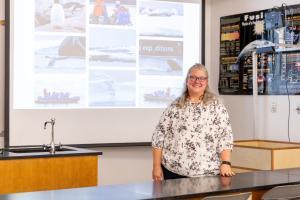
Her 34-day Antarctica trip this past spring was an expedition cruise. “The goal of the expedition is education and for us to get off the ship as much as possible. We would get in little motorboats, land on islands where humans have never been and go out in waters where there are penguins, icebergs or whales; you’re in it, you’re on it, you’re touching and smelling it. It is an amazing experience. There are lectures throughout the day and activities. There are also research scientists of all kinds and a lab on board with actual research happening first-hand.”
Reif says she would sit down with the two other geologists on board to look over geologic maps and discuss plate tectonics. “The word ‘geologist’ means to study the Earth, its climate, ocean, weather, glaciers, rocks and volcanoes, so we would share our knowledge and experiences,” she explains. Other days she would view items research scientists brought up from the ocean or watch with an ornithologist from the back of the boat as albatross flew by. “The ship also does citizen science. For instance, if we could get a good picture of a whale’s fluke (tail), there’s a citizen science site where you can post a picture of the fluke from anywhere in the world, and if that whale is in the database, they can see where it’s moved.”
There was a bit of a scare when boilers on the ship failed, but the crew and passengers bundled up and adjusted while repairs were made.
“We were going into the huts of these polar explorers who were trying to get to the South Pole for the first time; their camps are still there. It was amazing to be in this room where they lived and worked the last moments before they died. When we lost power, we were in the Bay of Whales, which is where Roald Amundsen, the Norwegian voyager of the Heroic Age of Antarctic Exploration in the early 1900s, had his camp. He camped on the ice, so his camp is gone, because ice moves. The morning that we lost our boilers was also the morning that we made the world record of being the most southerly ship ever.”
Other highlights were floating among a pod of whales who were logging (sleeping), with one blue whale going under the boat, and walking near penguins. “We saw some penguins that most people never get to see because they live on one single island in the middle of nowhere.”
Bringing a global perspective
She noted the effects of climate change are more apparent in the north than the south. “In the north it was a lot more obvious because the Arctic Ocean is warming much faster. I have images of fjords that are filled with a glacier, but now the glacier is a mile from where it was, probably within the last 100 years. The Antarctic isn’t warming as quickly because it’s buffered by a cold ocean.”
She said Antarctica is an unusual place because it is not well studied. “It is hard to get there and hard to live there. There are still a lot of unknowns. The maps and information are incomplete and sometimes may be incorrect, because we haven’t spent enough time there. Having conversations with other professionals, we discussed there’s more work to be done. “It was invigorating to remember that science is new and cool, and new things are happening all the time.”
And where to next for Reif? She plans on traveling to Botswana in southern Africa next summer.
“I was born and raised in rural central Illinois but have been all over the world. I tell my students, ‘Travel, no matter where you go, to see how people live, to talk to people who live a different life than you live, to eat food that is not the food you eat every day, just to breathe air that is not your air. These are things that change who you are, make you think differently, more globally.’”