
A RAD career
If you’ve ever made an unexpected trip to urgent care or the ER, chances are one of the first health care professionals you met was a radiologic technologist.
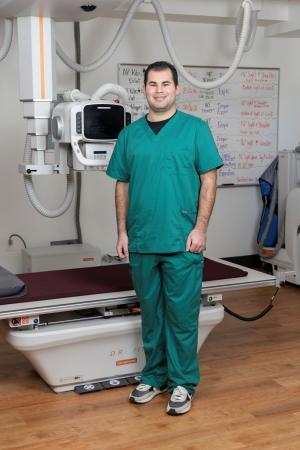
“If you’re getting an X-ray, you’re probably not having a real good day,” says second-year radiography student Nate Michael. “Being able to help people feel more comfortable in these moments, explaining what’s happening or simply just being a calming voice really matters.”
The desire to support patients during stressful moments is one of the reasons Michael chose radiography. “It combines patient interaction, compassion and hands-on care,” he explains. “One of the most important aspects of an X-ray is that it’s a gateway to further areas of care.”
A rapidly growing field
Radiologic technology has expanded far beyond the hospital setting. Today, X-rays are performed in urgent care centers, orthopedic and pediatric clinics and a growing number of outpatient facilities. The Bureau of Labor Statistics projects more than 15,000 annual job openings in the field with a median wage around $77,600.
“With retirements, combined with the continued growth of outpatient facilities, there is an incredible demand for skilled rad techs,” explains LLCC Radiography Program Director Janelle Murphy.
To meet that need, the LLCC Radiography program expanded to a 20-student cohort in 2025 and again this year to 24 students.
The program regularly receives more applications than openings. LLCC Radiography is recognized for its curriculum, strong clinical partnerships and 100% job placement rate upon graduation.
The demand for qualified radiographers is so high that employers aren’t waiting for graduation day to recruit new talent. Murphy notes that employers are eager to secure students before they even complete the program. “Our students are being offered positions before they even finish,” she says, emphasizing just how competitive the hiring landscape has become.
Expanded learning environment
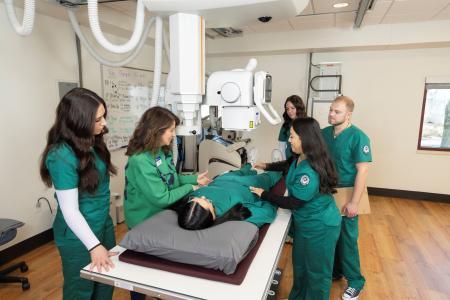
This year, LLCC also opened a new lab equipped with a brand-new, ceiling-mounted digital X-ray unit. “It elevates the learning experience,” says first-year student Andrea Jimenez Chairez. “It’s comparable to what we use in the hospitals and clinics, so there’s a transfer of learning to our hands-on experience.”
Students begin classroom instruction in June, learning 25 foundational X-rays before fall semester.
“I felt confident on my first day of clinicals because the program emphasizes the strong fundamentals and strong building blocks before you’re ever put in front of a patient,” explains Michael.
“Our clinical partners — Memorial, St. John’s and Springfield Clinic — build rotations so students experience different modalities within the profession,” Murphy explains.
Students rotate through large and small hospitals, emergency departments, surgery, pediatrics, orthopedics and urgent care. For Jimenez Chairez, the variety was the huge draw. “Every day can be so different. You’re always helping people, and you’ll never be bored.”
A program built on preparation
The LLCC associate of applied science degree in radiography requires 17 credit hours of general education courses, which Murphy strongly suggests students complete before beginning the program. She hosts monthly online information sessions required for applicants. The sessions cover the application process, classes, clinicals and expectations.
“I chose the LLCC program because of its strong reputation and deep connections with the Springfield medical community,” Michael says. “The level of check-ins, oversight and professionalism has been top tier.”
In May, he will graduate and sit for the American Registry of Radiologic Technologists (ARRT) certification exam. He plans to continue his education in radiation therapy and feels well prepared.
“LLCC is a fantastic program with fantastic instructors. The program has the history and reputation to prove it. Ultimately, you’ll come out confident in your skills and proud of what you’ve accomplished.”